
A Carefully Measured Life
Spoon Theory, Brain Injury Awareness Month, and the Art of Spending Well

There was a day I remember clearly. I had one appointment. Just one.
On my desktop calendar, it looked simple. I set my alarms for reminders: Warm up my truck for 5 minutes. Drive to One Community Health. Show up and get accupuncture. Drive home.
But that morning, I was already counting.
The in-town drive would cost me one spoon. Conversation would cost me one spoon. The fluorescent lights would cost me one spoon. The decision-making. The navigation. The noise.
By the time I poured my coffee, I was already budgeting.
If I go, I can’t also answer emails, look at paper mail or do bookkeeping.
If I go, I probably can’t cook dinner—a bagged salad and frozen pizza calls.
If I go, I will need quiet and to close my eyes afterward.
I wasn’t being dramatic. I was doing math.
March is Brain Injury Awareness Month—and this is the invisible arithmetic we don’t talk about enough.
The Story of the Spoon Theory
The Spoon Theory was created by Christine Miserandino to explain what it feels like to live with limited energy due to chronic conditions. Originally created for people dealing with Lupus, each spoon in Spoon Theory represents a unit of energy.
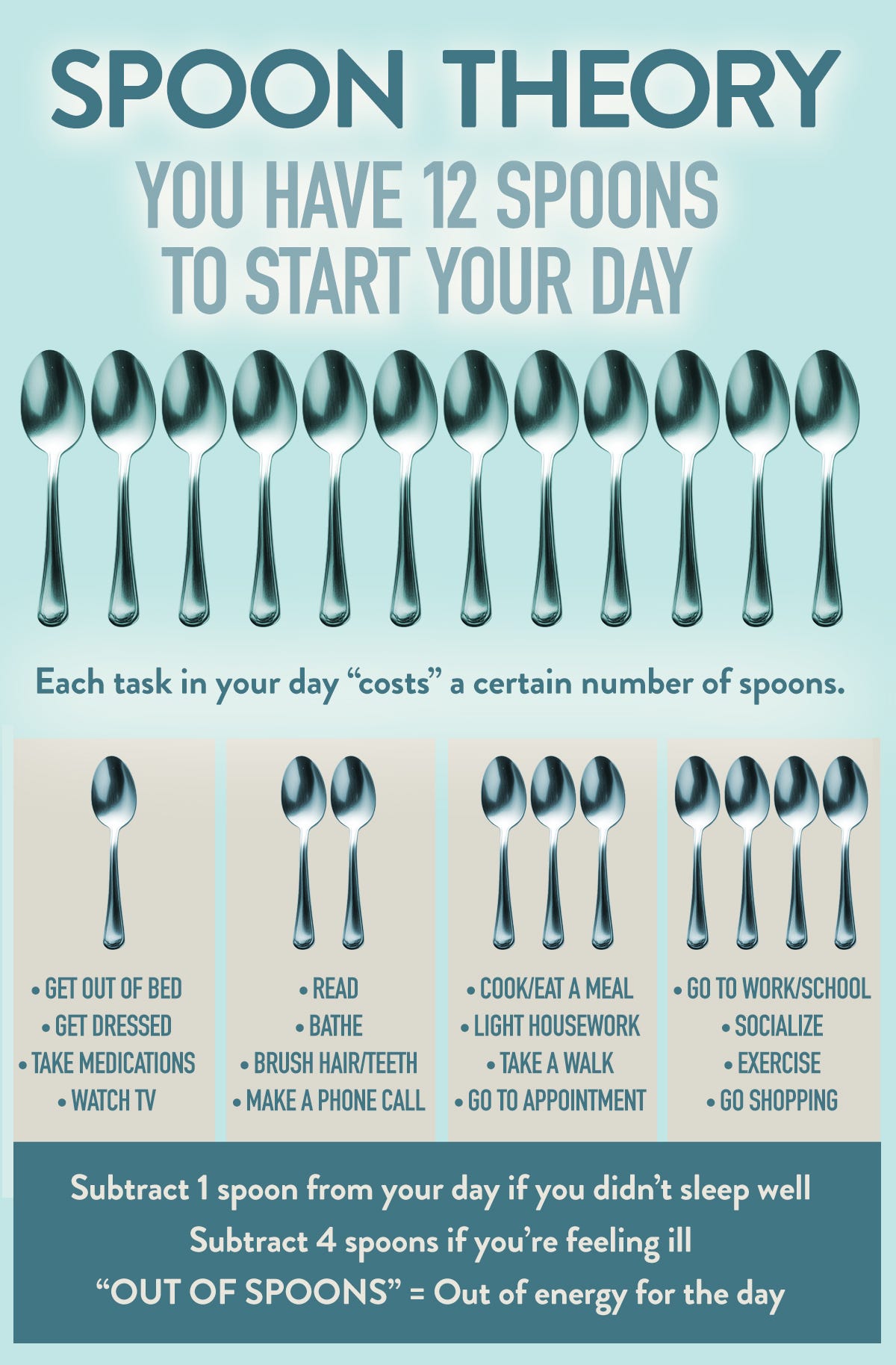
Healthy people wake up with a drawer full.
People with chronic illness, brain injury, grief, depression or neurodivergence wake up with a counted handful.
Every task costs something:
Showering
Deciding
Looking at the computer
Reading
Exercising
Doing math
Driving
Navigating
Grocery shopping
Socializing
When the spoons are gone, they are gone. The Spoon Theory helps frame day-to-day life. But for me, it became something more.
Spoonfuls of Something Good
At some point, I stopped imagining spoons as tokens and started imagining spoonfuls. If something costs me five spoons, what am I swallowing? Is it worth five spoonfuls of my life?
I began envisioning spoonfuls of something good—nourishment, sweetness, substance—to match what the activity costs.
If it’s draining, can I add sugar?
Can I add laughter?
Can I add companionship?
A spoonful of sugar makes the medicine go down.
If I’m going to spend my spoons, I want to know what I’m consuming in return.
Big Hairy Audacious Goals (The Slow Way)
Spoon Theory doesn’t eliminate ambition. It reshapes it. Big Hairy Audacious Goals still exist. Dreams still exist. But the steps toward them must be:
Slow
Steady
Sustainable
Measured
You can’t brute-force a vision when your energy is finite. You build it deliberately. One spoon at a time.
Saving My Vision
For me, vision is expensive. Visual processing drains me faster than most other activities. Screens. Driving. Reading. Crowded visual environments.
If I want freedom later in the day, I have to limit visual activity earlier. I try to “save my vision” for the really important things:
Driving to an appointment.
Showing up for something meaningful.
Or hopefully, something joyful.
Things that don’t require as much from my vision are easier for me to sustain.
That’s one reason my music projects are good for me. They involve learning, rhythm, collaboration—but they don’t tax my vision in the same way.
It’s a different channel of energy. And that matters.
Use Your Nos to Save Your Yeses

Living with spoon math means boundaries aren’t rude— they’re survival. “Use your Nos to save your Yeses.” Every no protects a future yes.
Every declined invitation might mean:
Yes to a creative project.
Yes to a meaningful conversation.
Yes to showing up fully when it matters.
Can You Get Spoons Back?
People always ask this. Yes. But not through pushing. Not through proving. Spoons return through restoration.
I sometimes picture illustrated spent spoons crossed out in my marker pad—and restorative activities gently uncrossing them.
Restorative activities look different for everyone. For me, they can include:
Acupuncture
Massage
Listening to music
Watching a favorite show
Taking a bath
Soaking in a hot spring
Hugging
Qi’gong
Rest is not indulgence. It is maintenance.
The Power of Togetherness
One of the most beautiful surprises? Restorative activities can be even more powerful when shared.
The right company doesn’t drain spoons. It multiplies sweetness. Togetherness can intensify restoration. The right presence is intrinsic.
A Carefully Measured Life
Measured does not mean small. Measured means intentional. It means choosing:
What deserves my vision.
What deserves my energy.
What deserves my spoonfuls.
Brain injury has forced clarity. It has stripped away excess. It has revealed what truly nourishes me.
An Activist Closing
During Brain Injury Awareness Month, I don’t just want awareness. I want respect.
Respect for invisible math.
Respect for pacing.
Respect for people who leave early.
Respect for people who cancel.
Respect for people who say no.
We are not unreliable. We are calculating survival.
If you love someone living with brain injury:
Believe them when they say they’re tired.
Trust them when they set limits.
Understand that showing up may cost more than you see.
And if you live this way too: Your life is not small.
It is deliberate.
It is strategic.
It is brave.
Let’s stop glorifying burnout. Let’s start honoring sustainability. This month, I invite you to notice your own spoons.
Where are you overspending?
What restores you?
What deserves your yes?
Build your life accordingly.